- Propers (Collect and Lessons) for the Sixteenth Sunday after Trinity, with hymns.
- Link to “Watch this Sunday’s live-stream” on our parish website.
- Parish Announcements for the week of October 5th, 2025.
- Rector’s Ramblings: St. Francis of Assisi
The Collect.
O LORD, we beseech thee, let thy continual pity cleanse and defend thy Church; and, because it cannot continue in safety without thy succour, preserve it evermore by thy help and goodness; through Jesus Christ our Lord. Amen.
The Epistle. Ephesians iii. 13.
I DESIRE that ye faint not at my tribulations for you, which is your glory. For this cause I bow my knees unto the Father of our Lord Jesus Christ, of whom the whole family in heaven and earth is named, that he would grant you, according to the riches of his glory, to be strengthened with might by his Spirit in the inner man; that Christ may dwell in your hearts by faith; that ye, being rooted and grounded in love, may be able to comprehend with all saints what is the breadth, and length, and depth, and height; and to know the love of Christ, which passeth knowledge, that ye might be filled with all the fulness of God. Now unto him that is able to do exceeding abundantly above all that we ask or think, according to the power that worketh in us, unto him be glory in the church by Christ Jesus throughout all ages, world without end. Amen.
The Gospel. St. Luke vii. 11.
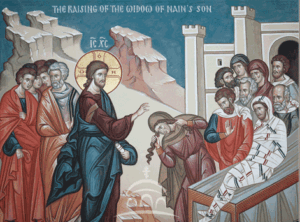
AND it came to pass the day after, that Jesus went into a city called Nain; and many of his disciples went with him, and much people. Now when he came nigh to the gate of the city, behold, there was a dead man carried out, the only son of his mother, and she was a widow: and much people of the city was with her. And when the Lord saw her, he had compassion on her, and said unto her, Weep not. And he came and touched the bier: and they that bare him stood still. And he said, Young man, I say unto thee, Arise. And he that was dead sat up, and began to speak. And he delivered him to his mother. And there came a fear on all: and they glorified God, saying, That a great prophet is risen up among us; and, That God hath visited his people. And this rumour of him went forth throughout all Judaea, and throughout all the region round about.
Hymns for this Sunday – Hymn numbers are from the 1940 Hymnal:
Processional Hymn: Praise my soul the King of Heaven – #282
Sermon Hymn: All people that on earth do dwell – #278
Communion Hymn: Let all mortal flesh keep silence – #197
Recessional Hymn: There’s a wideness in God’s mercy – #304
You’ll notice the hymns above have links…if you don’t recognize a particular hymn, please click the link and view a short YouTube video where the music is played. Even if you do recognize the hymn…it may be a different tune than you are used to.
The upcoming YouTube live-stream will always be found at “Watch this Sunday’s live-stream,” accessible from the menu bar at the top of the website home page. If we are not doing a live-stream for any reason, there will be a link to a past Sunday service to aid in your worship if you aren’t able to be with us in person.
If a live-stream of a Sunday service is accomplished, the audio of that Sunday’s sermon will usually be posted sometime Sunday evening on the media page on our website.
On any given day, check our “Current operating status” – in other words, whether or not the church is open for services or office hours, in case of inclement weather or unusual episodes (like the sabotage of transformers a few years ago). Check for changes to the service schedule (to include seasonal services such as Holy Week and Christmas) at Services and Office Hours.
The weekly parish email is reproduced on the News and announcements page. In addition, each of our after-service Christian Education sessions will have a post there where you can review the class video and access any handouts that were available. You’re also welcome to leave a comment or a question about the class on that page as well!
And lastly…if you ever want to ask a question, make a comment, contact someone about a ministry opportunity…please drop us a line using our church contact page. We’ll get your question or concern directed to the right person.
To volunteer for our media team, please contact our IT/AV/Social media specialist, John Fesq, at video.christchurchanglican@gmail.com.
(Sixteenth Sunday after Trinity)
Christian Education: John Fesq is facilitating the viewing of a series of Sunday School class videos from Holy Trinity Reformed Episcopal Church in Fairfax, VA. The class is an introduction to one of the works of Richard Hooker, who was an an important and influential English Reformer in the mid to late 1500’s. In particular, we will be exposed to Book Five of his “Laws of Ecclesiastical Polity.” The class will look at the Anglican underpinnings and viewpoints of such topics as:
- Worship
- Church buildings and settings (this Sunday’s lesson, Week 3)
- Preaching
- The Book of Common Prayer
- Liturgy
- Sacraments
- Traditional ceremonies and services
- Ministry
The class will be viewed after Sunday service outside the sanctuary on our big television screen, after we’ve had time to fellowship for a little bit. The classes tend to run 45 minutes to an hour, not including any discussion we’d like to have afterwards.
We encourage you to plan to make time after Sunday services to stay and learn with us!
The video (and handout if there is one) for each week’s lesson is posted on the website in our News and Announcements section. If you can’t be here for a lesson, or if you just want to go back over it, go to that Sunday lesson’s page. At the bottom of each lesson’s page, there’s an area to leave comments and questions! We’d love to hear from you if you have either!
Midweek (Wednesday) Eucharist: Please note that by request of the Altar Guild, our usual Wednesday service will not be held this week; we will return to our regular schedule, Lord willing, next week. We ordinarily offer a service of Holy Communion – also known as the Holy Eucharist, the Lord’s Supper, or the Mass) at 10:00 on Wednesday mornings. Please note that this service includes an opportunity for the laying on of hands and anointing with oil for healing, for those who may desire this ministry. The Propers and Homily for the Wednesday service typically commemorate a saint whose day falls in that week.
Please Note: We are continuing to look for the following volunteers:
- Altar Guild – Please see Sandy, after the service, if you are willing to serve God and our parish by helping to prepare the altar and chancel for services.
- Fellowship Meal Team – Please see Amanda or Lindsey if you are willing to bring a main course, salad or side, bread, or dessert. The more folks who participate, the less each individual or family needs to spend!
- Altar Flowers – We are now doing our own altar flowers; donations toward the cost of purchasing flowers (significantly less than purchasing pre-made arrangements!), as well as donations of time and talent if your suite of skills include floral arrangements, are greatly appreciated. Please see Amanda if you can assist.
- Housekeeping – Another cost-cutting measure: we are moving toward shifting the cleaning of the church to an “in-house” operation. Volunteers to assist are greatly welcomed – please see Lindsey.
This past Saturday, the 4th of October, was the commemoration of St. Francis of Assisi, one of the most beloved of non-Biblical saints, revered for his love of the poor – and of Creation. The son of a prosperous cloth-merchant in the Italian town of Assisi, Francis was born in the late 12th century (1182), his early youth was spent in the pursuit of pleasure, and aimless attempts at military glory. One day, in the church of San Damiano, he seemed to hear Christ saying to him, “Francis, repair my falling house.”He took the words literally, and sold a bale of silk from his father’s warehouse to pay for repairs to the church of San Damiano. His father was outraged, and there was a public confrontation at which his father disinherited and disowned him, and he in turn renounced his father’s wealth – one account says that he not only handed his father his purse, but also took off his expensive clothes, laid them at his father’s feet, and walked away naked.
He declared himself “wedded to Lady Poverty,” renounced all material possessions, and devoted himself to serving the poor. In his day the most dreaded of all diseases was something known as leprosy. Some modern scholars suggest that it was probably not the same as either the modern or the Biblical disease of that name, but in either case, lepers were kept at a distance and regarded with fear and disgust. Francis cared for them, fed them, bathed their sores, and kissed them.
Since he could not pay for repairs to the Church of San Damiano, he undertook to repair it by his own labors. He moved in with the priest, and begged stones lying useless in fields, shaping them for use in repairing the church. He got his meals, not by asking for money so that he might live at the expense of others, but by scrounging crusts and discarded vegetables from trash-bins, and by working as a day laborer, insisting on being paid in bread, milk, eggs, or vegetables rather than in money. Soon a few companions joined him.
After three years, in 1210, the Pope authorized the forming of the Order of Friars Minor – which, literally translated, is “Little Brothers” – commonly called the Franciscans. Francis and his companions took literally the words of Christ when he sent his disciples out to preach:
“And as ye go, preach, saying, The kingdom of heaven is at hand… freely ye have received, freely give. Provide neither gold, nor silver, nor brass in your purses, nor scrip for your journey, neither two coats, neither shoes, nor yet staves…”
In other words they would have no money, and no property, individually or collectively. Their task was to preach, “using words if necessary,” but declaring by word and action the love of God in Christ. Francis was partial to a touch of the dramatic, and it was probably he who set up the first Christmas manger scene, to bring home the Good News of God made Man for our salvation to men’s hearts and imaginations as well as to their intellects.
In 1219, Francis went to the Holy Land to preach to the Muslims. He was given a pass through the enemy lines, and spoke to the Sultan, Melek-al-Kamil. Francis proclaimed the Gospel to the Sultan, who replied that he had his own beliefs, and that Muslims were as firmly convinced of the truth of Islam as Francis was of the truth of Christianity. Francis proposed that a fire be built, and that he and a Muslim volunteer would walk side by side into the fire to show whose faith was stronger. The Sultan said he was not sure that a Muslim volunteer could be found.
Francis then offered to walk into the fire alone. The Sultan was deeply impressed, but remained unconverted. Francis proposed an armistice between the two warring sides, and drew up terms for one; the Sultan agreed, but, to Francis’s deep disappointment, the Christian leaders would not. Francis returned to Italy, but a permanent result was that the Franciscans were given custody of the Christian shrines then in Muslim hands; they remain in that role today.
Back in Italy and neighboring countries, the Order was suffering from its own success. Then, as now, many persons were deeply attracted by Francis and his air of joy, abandonment, and freedom. What they overlooked is that these were made possible only by his willingness to accept total poverty, not picturesque poverty but real dirt, rags, cold, and hunger, and lepers with real pus oozing from their sores and a real danger of infection. Many idealistic young men were joining the Order in a burst of enthusiasm and then finding themselves not so sure that such extremes of poverty were really necessary.
When there were only a few friars, they were all known to Francis personally, and the force of his personality kept the original ideals of the Order alive in them. Now that the Order was larger, this was no longer enough. In 1220 Francis resigned as minister-general of the Order, and in 1221 he agreed to a new and modified rule, which he did not approve, but could not resist. He died on 4 October 1226.
Of all the post-Biblical saints, Francis is perhaps the most popular and admired, but probably the least imitated: few can match his total identification with the poverty and suffering, the joy and the faith of Christ. His patronage of the poor, and his association with animals, have given a somewhat “New Age,” neo-hippie cast to his veneration in modern times. But in fact, he was quite orthodox in his faith and practice, despite his extreme asceticism, and might well have looked askance at some of those who champion him most vociferously today!
Keith Warner, a Roman Catholic Franciscan of the Order of Friars Minor, notes that St. Francis was not an environmentalist in the modern sense of the word, but he was a great lover of God’s creation, long before there was such a word as environmentalism, or ecology. Warner recommends, and I concur, that we look to Francis as an example of someone who prayed in nature and discovered more about both God and himself through the practice of contemplative prayer in natural surroundings: seeking God, in His good Creation.
Francis spent a third to half of each year praying in nature and the wilderness, living in hermitages, caves, under lean-to’s, on mountain-sides, and he interspersed this with preaching. There was something about that experience of being intimately related to Creation itself that helped him grow more fully into the mystery of God. And that’s what we are desperately in need of today, I believe, because we are so alienated from the earth and from ourselves. Again, I often feel closest to God in the midst of His Creation; and if I am too long apart from it, that connection grows frayed and tenuous.
Pope John Paul II named Francis the patron saint “of those who promote ecology” in 1979. Ecology in Europe refers to what we in the United States call environmentalism, or conservationism, and not just the science of ecology. Francis is the patron of those who cultivate ecological consciousness, but that means a lot more than being the patron of environmental educators, or making regular donations to the Sierra Club, or – heaven forbid! – supporting the “Green New Deal”! His example really points to a mystical or spiritual vision for all of the created world as brothers and sisters, as he describes in his Canticle of Creation – sometimes known as the Canticle of Brother Son and Sister Moon.
Even if we are not called to the extreme asceticism of Saint Francis – and I myself have a much more Benedictine cast to my spirituality – I believe that this, the contemplation of God in the midst of His created order, is something we could profitably learn from Francis’ example. While I do not accept uncritically all the ravings of today’s radical environmentalists, I have long been of the belief that we have a positive theological, as well as ethical, responsibility to care for this good Earth which God has given us. We would think someone who claimed to love Rembrandt, but then slashed a Rembrandt painting, had taken leave of his senses – or else was lying about loving him in the first place. Similarly, I do not think we can justly claim to love the Creator if we willfully or knowingly abuse His Creation.
Let us, then, following the example of St. Francis, be attentive to the presence of God both in the things of nature, and in the people around us, particularly those who are less fortunate. And let us do so in the Name, and following the example, of Christ our Lord: that Incarnate Word of God through whom all things were made, and who came among us as one who serves – and who livest and reignest with the Father and the Holy Ghost, one God, now and forever, and unto ages of ages. Amen.