- Propers (Collect and Lessons) for Saint Michael and All Angels, with hymns.
- Link to “Watch this Sunday’s live-stream” on our parish website.
- Parish Announcements for the week of September 28th, 2025.
- Rector’s Ramblings: The Feast of St. Michael and all Angels, commonly called “Michaelmas”
The Collect.
O EVERLASTING God, who hast ordained and constituted the services of Angels and men in a wonderful order; Mercifully grant that, as thy holy Angels always do thee service in heaven, so, by thy appointment, they may succour and defend us on earth; through Jesus Christ our Lord. Amen.
For the Epistle. Revelation xii. 7.
THERE was war in heaven: Michael and his angels fought against the dragon; and the dragon fought and his angels, and prevailed not; neither was their place found any more in heaven. And the great dragon was cast out, that old serpent, called the Devil, and Satan, which deceiveth the whole world: he was cast out into the earth, and his angels were cast out with him. And I heard a loud voice saying in heaven, Now is come salvation, and strength, and the kingdom of our God, and the power of his Christ: for the accuser of our brethren is cast down, which accused them before our God day and night. And they overcame him by the blood of the Lamb, and by the word of their testimony; and they loved not their lives unto the death. Therefore rejoice, ye heavens, and ye that dwell in them. Woe to the inhabiters of the earth and of the sea! for the devil is come down unto you, having great wrath, because he knoweth that he hath but a short time.
The Gospel. St. Matthew xviii. 1.
AT the same time came the disciples unto Jesus, saying, Who is the greatest in the kingdom of heaven? And Jesus called a little child unto him, and set him in the midst of them, and said, Verily I say unto you, Except ye be converted, and become as little children, ye shall not enter into the kingdom of heaven. Whosoever therefore shall humble himself as this little child, the same is greatest in the kingdom of heaven. And whoso shall receive one such little child in my name receiveth me. But whoso shall offend one of these little ones which believe in me, it were better for him that a millstone were hanged about his neck, and that he were drowned in the depth of the sea. Woe unto the world because of offences! for it must needs be that offences come; but woe to that man by whom the offence cometh! Wherefore if thy hand or thy foot offend thee, cut them off, and cast them from thee: it is better for thee to enter into life halt or maimed, rather than having two hands or two feet to be cast into everlasting fire. And if thine eye offend thee, pluck it out, and cast it from thee: it is better for thee to enter into life with one eye, rather than having two eyes to be cast into hell-fire. Take heed that ye despise not one of these little ones; for I say unto you, That in heaven their angels do always behold the face of my Father which is in heaven.
Communion Hymn: Angels and ministers, spirits of grace – #122
Recessional Hymn: Ye watchers and ye holy ones – #599
The upcoming YouTube live-stream will always be found at “Watch this Sunday’s live-stream,” accessible from the menu bar at the top of the website home page. If we are not doing a live-stream for any reason, there will be a link to a past Sunday service to aid in your worship if you aren’t able to be with us in person.
If a live-stream of a Sunday service is accomplished, the audio of that Sunday’s sermon will usually be posted sometime Sunday evening on the media page on our website.
Our website is found at cca-nc.org. It’s our “one-stop shop” for information about Christ Church Anglican.
On any given day, check our “Current operating status” – in other words, whether or not the church is open for services or office hours, in case of inclement weather or unusual episodes (like the sabotage of transformers a few years ago). Check for changes to the service schedule (to include seasonal services such as Holy Week and Christmas) at Services and Office Hours.
The weekly parish email is reproduced on the News and announcements page. In addition, each of our after-service Christian Education sessions will have a post there where you can review the class video and access any handouts that were available. You’re also welcome to leave a comment or a question about the class on that page as well!
And lastly…if you ever want to ask a question, make a comment, contact someone about a ministry opportunity…please drop us a line using our church contact page. We’ll get your question or concern directed to the right person.
To volunteer for our media team, please contact our IT/AV/Social media specialist, John Fesq, at video.christchurchanglican@gmail.com.
(Fifteenth Sunday after Trinity)
If you are visiting us: Welcome to Christ Church Anglican, Southern Pines! Thank you for being with us. We are very pleased to have you join us for the service, and hope that your worship here is a blessing to you. Please sign the guest book on the table in the narthex, and if you wish, share your email or other contact information with us. And may God bless you!
Father Tom returns (Lord willing!) to the pulpit and altar this Sunday, September 28th: I am extremely grateful for the prayers and other support I received during my recent bouts with not one, but two emergency surgeries: the first an emergency appendectomy, and the second, just as I was recovering from the first, emergency eye surgery to re-attach a torn and detaching retina. But thanks be to God, and with much gratitude to my loving wife Amanda (who also suffered some health issues during that period), I hope and plan to return this Sunday to celebrate the Eucharist and preach God’s Word to His people here at Christ Church Anglican. Many, many thanks to George, Tedd, Barbara, Austin, and again, Amanda, for all your work in holding things together during my most unexpected and frustrating absence!
Christian Education: We started our Christian Education series last Sunday.
John Fesq is facilitating the viewing of a series of Sunday School class videos from Holy Trinity Reformed Episcopal Church in Fairfax, VA. The class is an introduction to one of the works of Richard Hooker, who was an an important and influential English Reformer in the mid to late 1500’s. In particular, we will be exposed to Book Five of his “Laws of Ecclesiastical Polity.” The class will look at the Anglican underpinnings and viewpoints of such topics as:
- Worship
- Church buildings and settings
- Preaching
- The Book of Common Prayer
- Liturgy
- Sacraments
- Traditional ceremonies and services
- Ministry
The class will be viewed after Sunday service outside the sanctuary on our big television screen, after we’ve had time to fellowship for a little bit. The classes tend to run 45 minutes to an hour, not including any discussion we’d like to have afterwards.
We encourage you to plan to make time after Sunday services to stay and learn with us!
Last week’s class was the first in the series, “An Introduction to Richard Hooker”. If you missed it, you can view the video we watched and download a class handout from here.
Vestry: There will be a short meeting of the Vestry on Sunday, after Christian Education.
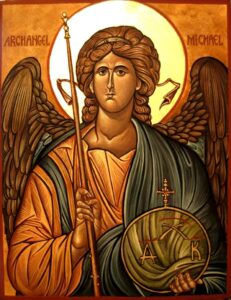
The Feast of St. Michael and All Saints, commonly called Michaelmas.
“There was war in heaven: Michael and his angels fought against the dragon; and the dragon fought and his angels, and prevailed not; neither was their place found any more in heaven.”
The scriptural word “angel” (in Greek, angelos) means, literally, a messenger. According to the biblical witness, angels are messengers from God; they can be visible or invisible, and may assume human or nonhuman forms. Of the angels who appear in the biblical narrative, only four are given names: two of them, Michael (Hebrew, “Who is like God?”) and Gabriel (“God is my strength”) are named in the canonical Scriptures; Raphael (“God heals”) in the deuterocanonical book of Tobit; and Uriel (“God is my light”) in 2 Esdras and in the apocryphal writings, the Book of Enoch and the Testament of Solomon.
Michael appears in the Book of Daniel as “one of the chief princes” of the heavenly host and as the special guardian or protector of Israel (in Daniel 10 and 12). In the Book of Revelation he is the principal warrior of the heavenly host against the dragon, who was “thrown down to the earth, and his angels were thrown down with him” (Revelation 12). In the Epistle of Jude, Michael disputes with Satan over the body of Moses and declares, “The Lord rebuke you.” (The epistle may be citing a lost passage in the Assumption of Moses, an apocryphal Jewish book.)
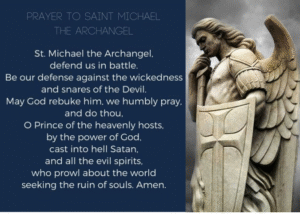
While not all Anglicans feel comfortable praying to saints, including angels, this prayer (also found in the second image above) has a long provenance in the Western Church:
St. Michael the Archangel, defend us in battle. Be our defense against the wickedness and snares of the Devil. May God rebuke him, we humbly pray, and do thou, O Prince of the heavenly hosts, by the power of God, thrust into hell Satan, and all the evil spirits who prowl about the world seeking the ruin of souls. Amen.
This reinforces the fact that Satan is not – as is sometimes and erroneously believed – the opposite number of God, but only of St. Michael the Archangel… and that St. Michael defeats that old serpent, the devil, rather handily, in the final battle.
The second-century Christian text Shepherd of Hermas depicts Michael as an angel of majestic aspect, who has authority over “this people and governs them, for it was he who gave them the law… and [he] superintends those to whom he gave it to see if they have kept it.” In the second-century Testament of Abraham Michael’s intercession is so powerful that souls can be rescued even from hell, a passage that may have inspired the offertory antiphon in the former Roman Liturgy for the Dead: “May Michael the standard-bearer lead them into the holy light, which thou hast promised of old to Abraham and to his seed.”
The formal veneration of Michael began in the Christian East, where he was invoked particularly for the care of the sick. Associated with courage, protection, and divine intervention, defender of the faith and a warrior against evil, he is invoked as patron of those who go in harm’s way in the service of others, including military personnel, law enforcement officers, firefighters, paramedics, and other first responders.
On this Feast of Michael and all Angels, popularly called Michaelmas, we give thanks for the many ways in which God’s loving care watches over us, both directly and indirectly, and we are reminded that the richness and variety of God’s creation far exceeds our knowledge of it. The Holy Scriptures often speak of these created intelligences, other than humans – these beings known as angels – who worship God in heaven and act as His messengers and agents on earth.
A side note: angelion means “message, news” and evangelion means “good news”: godspell, in Old English), from which we get our word “gospel” (as well as the title of a famous musical!). And from evangelion we get our word “evangelist”: used in general to mean a preacher of the Good News of salvation, and, more narrowly, one of the four Gospel-writers: Matthew, Mark, Luke, and John, known as “the Evangelists.”
So, what is the value to us of remembering the Holy Angels? Well, since they appear to excel us in both knowledge and power, they remind us that, even among created things, we humans are not the top of the heap. And since it is believed that demons are angels who have chosen to disobey God and to be His enemies, rather than His willing servants, they also serve to remind us that the higher we may climb, the lower we can fall. The greater our natural gifts and talents, the greater the damage if we turn them to bad ends. The more we have been given, the more will be expected of us.
And, in the picture of God sending His angels to help and defend us, we are reminded that apparently God, instead of doing all good things directly – by fiat, as it were, the direct exercise of His divine power – often prefers to do them through His willing servants, enabling those who have accepted His love to show their love for one another, in return. Delegated responsibility, as it were! Or maybe, delegated charity, in the senses of caritas: caring, or loving-kindness, in which the creatures show forth the love of the Creator.
So, Archangels are the most powerful angels, right…? Well, no. Not exactly. Based on the writings of St. Paul – who spoke of such angelic beings as angels and archangels, but also of thrones, dominions, principalities, and powers – and a later writer called Dionysios the Areopagite – it is generally considered that there are nine orders, or “choirs,” of angelic beings.
The lowest order, called simply angels, are God’s messengers, and His envoys to – and guardians of – the human race. The highest order, the seraphim, devote themselves to contemplating God, beholding Him face to face, and loving and praising Him. Those in between are sometimes differently ordered, depending on who’s making the list, but they include cherubim, dominions, thrones, principalities, powers, and archangels… the last-named being the one right above angels, proper.
Now, if these names sound familiar, and you’re not already a scholar of such things, it is probably from the well-known hymn, “Ye Watchers and Ye Holy Ones,” which we will sing as our recessional hymn on Sunday.
Note that the term “angels” can refer either to all nine orders, collectively; or only to the lowest order, just as the term “soldier” can refer to anyone in the army, or only to the enlisted men (as distinct from the officers). Each order helps to reveal and declare God’s glory to the order below. So archangels, as a class, are actually only the second-ranked order, or choir, of angelic beings, right above angels proper. Nonetheless, certain archangels, those specifically named – Michael, Gabriel, Raphael, and Uriel – appear to have been given special tasks by God, in the economy of salvation, such that they are elevated above all other angelic beings, regardless of the specific order to which they belong.
And one of those is St. Michael, the Captain of the Heavenly Host, who seems to have been delegated by God to be our defender against the forces of evil and chaos, and whose feast we celebrate today… at a time when, following the assassination of Charlie Kirk, attacks on Christian schools, and other assaults on the Faith, such protection seems urgently to be needed.
There is much more that could be said, but this has already gone on long enough… and probably then some! We should remember that, except for what is specifically attested in the Scriptures, this depiction of the angelic order is rather speculative: we should not expect to know and understand these matters in detail until we are in God’s nearer presence (and assuming that He chooses to share them with us, even then). But it is fascinating speculation, and it does tend to show us – as noted above – the many ways in which God cares for us, as well as the vast complexity and wonder of His Creation, even above and beyond the physical cosmos!
It shows us, as well, His willingness to delegate certain tasks to certain of His creatures: both physical and spiritual, both mortal and immortal. And so, may God Almighty send His holy angels to watch over us, and to protect us from all manner of harm, particularly in these troubled and troubling times in which we live. And may He bless and preserve us, and those we love, and – in the words of another favorite hymn – “save us from all ills, in this world and the next!”